Zomato is India’s leading restaurant discovery app. It was started by Deepinder Goyal and Pankaj Chaddah in 2008. Zomato works as an aggregator between restaurants and foodies.
It helps the foodies to discover, rate, and review the restaurants, and cafes based upon their experience across 10,000 cities in the 24 nations include, India, United States, Australia, United Kingdom, Canada, Turkey, UAE, Qatar, Portugal, South Africa, New Zealand, Chile, Brazil, Indonesia, Philippines, Czech Republic, Poland, Slovakia, and Sri Lanka.
Now let’s see, how Zomato was started,

Zomato Company Overview
| Point | Overview |
| Company Name | Zomato |
| Founded | 2008 |
| Founders | Deepinder Goyal & Pankaj Chaddah |
| Headquarters | Gurgaon, India |
| Industry | Food Delivery, Restaurant Discovery & Quick Commerce |
| Coverage | 10,000+ cities across 24 countries |
| App users | 90M+ monthly visitors (web + app combined) |
| Restaurant Partners | 1.5 lakh+ restaurants in India |
| Key Services | Food Delivery, Restaurant Reviews, Table Booking, Hyperpure, Zomato Gold, Zomaland, District App |
| Business Model | Multi-Channel platform (Marketplace + Delivery + B2B Supplies + Memberships) |
| Revenue Sources | Commissions, Delivery Fees, In-App Ads, Subscriptions, Hyperpure, Event Ticketing |
| Market Capital (2025) | ₹2.17 Trillion |
| Current Status | Public company (Listed on NSE & BSE) |
How Zomato Was Started?
Zomato was started with the name ‘Foodiebay’ in 2008 and was later renamed Zomato in November 2010. It happened because the founders didn’t want to confine themselves to only the Food Business and also to avoid confusion with the brand “eBay”, because it sounds similar to Foodiebay.
Firstly, Deepinder Goyal and Pankaj Chaddah started all the menu items from their nearby restaurant and list on their intranet website. After getting some popularity and regular traffic, they launched their public website in 2008. After launching the website, they started listing restaurants in Delhi NCR, and quickly extended to Kolkata and then Mumbai.
In 2012, the startup company launched a print version of the website in association with Citibank as “Citibank Zomato Restaurant Guide”. Additionally, Zomato extended its presence abroad to the UAE, Sri Lanka, Qatar, UK, the Netherlands, Turkey, Brazil, and so on.
Subsequently, Zomato ceaselessly expanded in the worldwide market and peaked in India too. It has a wide reach on its site- about 90 million people visit the site, and versatile applications.
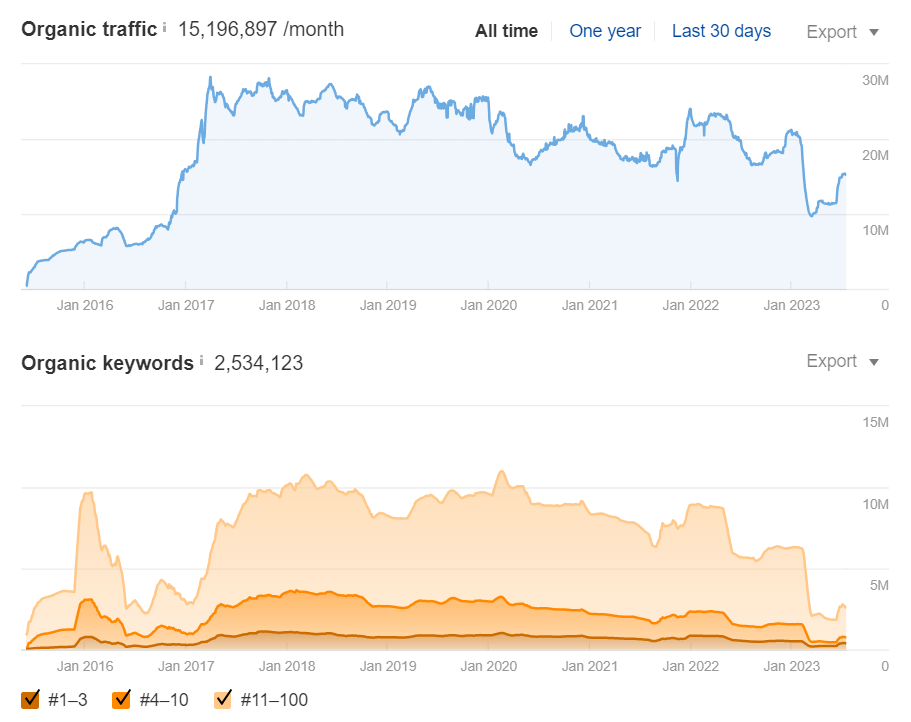
Now, Zomato is getting almost 15.2 Million traffic per month organically with more than 71 thousand backlinks. (As per Ahrefs.com)
Here is the organic traffic growth chart of Zomato since April 2015.

Zomato Funding Rounds
As of January 2026, Zomato has a market cap of ₹1.952 Trillion.
| Year | Round | Funding Amount | Investors |
| Jul, 2010 | Angel | $1M | Info Edge |
| Aug, 2010 | Seed | $1.03M | Info Edge, Sharad Malik, Vivek Khare, Info Edge Ventures |
| Sep, 2011 | Series A | $3M | Info Edge, Vivek Khare |
| Sep, 2012 | Series B | $2.3M | Info Edge Ventures |
| Feb, 2013 | Series C | $10.3M | Infor Edge Ventures |
| Nov, 2013 | Series D | $37.5M | Info Edge Ventures, Peak XV Partners |
| Nov, 2014 | Series E | $60M | Info Edge ventures, Vy capital |
| Feb, 2015 | Series E | $27.2M | Info edge |
| Apr, 2015 | Series F | $50M | Info edge ventures |
| Sep, 2015 | Series G | $60M | Teamsek, Vy capital |
| Feb, 2018 | Series H | $152M | Ant group |
| Oct, 2018 | Series I | $217M | Ant group |
| Feb, 2019 | Series I | $40M | Glade Brook Capital |
| Feb, 2019 | Series I | $62.2 M | Delivery hero and others |
| Jan, 2020 | Series J | $50M | Ant group and others |
| Mar, 2020 | Series J | $5M | Baillie Gifford |
| Aug, 2020 | Series J | $660M | Multiple investors |
| Feb, 2021 | Series J | $252M | Multiple investors |
| November, 2024 | Post-IPO | $1B | Multiple investors |
Zomato Acquisitions: Startups Acquired By Zomato
Zomato has previously acquired 13 other startups over time that helped it in a major expansion globally. The complete list is given below:
| Company Name | Year | Amount |
| MenuMania | July, 2014 | Undisclosed Amount |
| Lunchtime.cz and Obedovat.sk | August, 2014 | $3.25 Million |
| Gastronauci | September, 2014 | Undisclosed Amount |
| Cibando | December, 2014 | Undisclosed Amount |
| Urbanspoon | January, 2015 | $60 Million |
| Mekanist | April, 2015 | Undisclosed Amount |
| MapleGraph Solutions Private Limited | April, 2015 | Undisclosed Amount |
| Nextable | April, 2015 | Undisclosed Amount |
| Sparse Labs | September, 2016 | Undisclosed Amount |
| Runnr | September, 2017 | Undisclosed Amount |
| WOTU (rebranded as Hyperpure) | August, 2018 | Undisclosed Amount |
| TongueStun Food | September, 2018 | $18 Million |
| TechEagle | December, 2018 | Undisclosed Amount |
| Uber Eats | January, 2020 | $350 Million |
| Fitso | Jan, 2021 | Undisclosed Amount |
| Grofers | June, 2021 | $120 Million |
| BlinkIt | June, 2022 | $568 Million |
| WEPL and OTPL | Aug, 2024 | $244.2 Million |
Zomato Products and Services
They started with only a food discovery app. Now, they have expanded to various macro sections in the food industry,
Here’s a list of services given by Zomato,
- Restaurant Ratings & Reviews,
- Restaurant Search & Discovery,
- Online Order: Food Delivery,
- Quick 15-minute food delivery service
- Table Reservations
- Hyperpure: Ingredients supplied to restaurants,
- Gold: Restaurant premium subscription services
- Zomaland: Multicity of food and entertainment carnival
- Zomato LIVE: book tickets for Zomato live events
- District App: offers dining, entertainment and ticketing services
- Zomato Feeding India: NGO that works with Zomato to provide food support to underserved communities in India.
Zomato Business Model: How Zomato Works?
Zomato works as a three-sided marketplace that connects customers, restaurants, and delivery partners on one platform.
For customers, the process is simple.
- You open the Zomato app or website
- Search for restaurants near you, check menus, prices, photos, and reviews
- Place your order and make the payment
- Track your food in real time until it’s delivered
- After the food gets delivered, you can rate the restaurant and leave a review.
For restaurants, Zomato helps them list their outlet, upload menus, manage orders, track performance, and reach more customers online. It also gives them options to run ads and promotions to increase visibility.
For delivery partners, Zomato provides delivery requests, route support, and earnings based on completed orders.
Overall, Zomato focuses on expanding its food delivery network, improving customer experience, and building strong restaurant partnerships.
Along with food delivery, it has expanded into areas like Hyperpure (B2B supplies) and quick commerce through Blinkit.
Zomato Revenue Model: How Zomato Makes Money
Zomato does not earn from just one source. It has multiple revenue streams.
1. Online Ordering Service
Zomato takes a certain percentage from the restaurants on each sale made through the Zomato app/website.
2. In-App Advertising
Advertisement is one of the major contributors to Zomato’s Revenue. It allows restaurants to buy space or bid on a particular city on their app and pay for it. It can be a restaurant listing, banners, and sliders. It works similarly to Google search and display ads
3. Delivery Charges
Zomato charges a delivery fee from the users. It may depend upon your order size and the distance between you and the restaurant. It may vary from Rs.0 to Rs.50.
4. Organises Events
Zomato also started organising food events with a name “Zomaland“. The sale of event tickets and sponsorships contributed to their revenue. (Now Zomaland is Closed officially)

5. Zomato Hyperpure
It helps restaurants by delivering reliable and fresh groceries and ingredients like fresh fruits, vegetables, meat, fish, milk, and more. Zomato delivers these groceries to the restaurants and charges a delivery fee and a small commission from the Kirana store owners.
6. Zomato Gold
Zomato Gold is a membership program that gives special perks like a free dish or up to two free drinks every time you visit partner restaurants or bars in India. Members can use it any day, at any time, on any menu item.
You can buy the membership for 3 months or a year through the Zomato app. It gives some additional benefits to the customer, like buy 1, get 1 on cold drinks, extra discounts, free delivery, and much more.
Zomato Competitors
Zomato faces a lot of competition in India from several food delivery and restaurant discovery platforms. Swiggy is the direct competitor to Zomato in the food industry. Zomato’s other competitors are Eatsure, Deliveroo, and Freshmenu.
International Competitors Of Zomato
1)- Doordash
2)- UberEats
3)- Grubhub
4)- Postmates
5)- ChowNow
More About Zomato
Zomato Legal Name: Zomato Media Private Limited
Headquarter: Gurgaon, India
No. of Employees working with Zomato: over 18,730 employees
Delhi-NCR became Zomato’s biggest market in 2025, with over 4 crore more orders than Mumbai and Bengaluru, making it the top region for online food delivery.
Outside India, Zomato saw steady growth, especially in the Middle East. The UAE led with 2.3 lakh orders, followed by the US (1.2 lakh) and the UK (80,000).
In FY25 (ending March 2025), Zomato (now Eternal Ltd.) reported strong growth. Its operating revenue touched ₹20,243 crore, up 67% year-on-year, and the company posted a net profit of ₹527 crore, driven by food delivery, Blinkit, and Hyperpure.
FAQs – Zomato
When was Zomato Started?
Zomato was started as “Foodiebay” in 2008 by Deepinder Goyal and Pankaj Chaddah.
What is Zomato?
Zomato is a popular online food delivery and restaurant discovery platform. It allows users to discover nearby restaurants, read reviews, order food and book tables for lunch and dinner.
Is Zomato a startup?
Yes, Zomato is a startup that turned into a large food-tech platform. The startup entered the unicorn club in 2018.
Who invested in Zomato?
Zomato has multiple investors like Ant Group, Info Edge Ventures, Teamsek, Vy Capital and more.
Is Zomato an Indian company?
Yes, Zomato is an Indian Company.
In which year Zomato start delivery?
Zomato started its food delivery services in 2015.