Paytm – India’s most loved online payments app, started by Vijay Shekhar Sharma in 2010. And it played a significant role in the digital revolution of India. Paytm is also very well-known for its tagline, “Paytm Karo”, one of the most iconic jingles in Indian advertising history.
What started as a simple mobile recharge platform has grown into one of India’s largest fintech ecosystems, serving 540+ million users, 44+ million merchants, and touching everything from bill payments to stock investments.
Let’s explore how Paytm started,
Paytm Company Overview
| Point | Overview |
| Company Name | Paytm (One97 Communications Ltd.) |
| Founded | August 2010 |
| Founders | Vijay Shekhar Sharma |
| Headquarters | Noida, India |
| Industry | Fintech, Digital Payments & Financial Services |
| Coverage | Pan-India (Consumers + Merchants) |
| App Users | One of India’s most downloaded apps (first to cross 10 crore+ downloads) |
| Key Services | Wallet, UPI, Payments Bank, Payment Gateway, Recharge & Bills, Ticket Booking, Paytm Money, Paytm Gold, Soundbox, Mini App Store |
| Business Model | Multi-Revenue Model (B2C + B2B + Merchant Solutions + Financial Services Distribution) |
| Revenue Sources | Wallet Charges, Service Commissions, Payment Gateway Fees, Paytm Payments Bank Services, Card distribution service, MDR and more |
| IPO | India’s largest IPO (2021) — Listed under One97 Communications, ₹18,300 crore raised |
| Current Status | India’s leading merchant payments platform, pivoting to partner-led financial services after the 2024 regulatory reset |
How Paytm Started – Paytm Success Story
The story of Paytm starts even before Paytm. Vijay Shekhar Sharma, a first-generation entrepreneur from a small town in Uttar Pradesh, had already built and sold his first venture, indiasite.net, to a US-based company for $1 million in just 2 years.
After getting an exit, he worked for a while in the corporate world. Later on, Vijay Shekhar started One97 Communications (Now Paytm’s Parent Company) in 2000, which provided phone number details via SMS. After a lot of back-and-forth with this business. He found a big gap in the online financial transaction space.
And finally, he launched Paytm.com(Pay through mobile) on 8th July 2010. With this website, he also launched the Paytm App. This platform’s focus was to help customers do their mobile recharges, DTH recharges, bill payments, ticket bookings, etc.
Demonetization: A Turning Point For Paytm Growth (2016)
A major turning point for Paytm came in November 2016, when the Government of India announced the demonetization of ₹500 and ₹1000 notes.
Suddenly, millions of people needed a digital way to make payments. Paytm was already available on many smartphones, which helped it grow rapidly during this period.
The impact was huge:
- App downloads crossed 100 million within weeks
- Wallet users exceeded 200 million by the end of 2016
- Daily transactions increased 5–7 times
- Small merchants like vegetable sellers and auto drivers started accepting Paytm payments
This event accelerated India’s shift toward digital payments and helped Paytm become a household name.
Paytm Features, Products and Services
Paytm started with a simple digital financial platform to help its users do mobile recharges, DTH recharges, and bus ticket bookings. Over time, it has become the most lovable payment platform, and Paytm offers many services for both consumers and businesses.
Let’s start with one of its revolutionised features, Paytm Wallet,
For Consumers
Paytm Wallet (2014)
Paytm wallet is the first digital wallet in India. Here, you can store money digitally and use it to send and receive money with your friends and family. All without needing net banking or a card.
And from 2015, they’ve added Bill Payments, Movie Tickets, and QR codes to receive and send payments.
Note: Currently, Paytm Wallet services are restricted as per RBI guidelines. Users cannot add new money to the wallet, but they can use or withdraw the existing balance. Some Paytm services, like UPI and merchant payments, continue through partner banks.
Paytm Payment Bank (2017)
Paytm Payment Bank is another digital revolution, making banking simple and more accessible for everyone. With zero account opening fees or minimum balance requirements, consumers can easily open savings or current accounts. It also offered a “Paytm Payment Debit Card” with lots of similar benefits without any annual charges.
Note: As per RBI directions issued in 2024, Paytm Payments Bank is currently restricted from accepting new deposits or onboarding new customers. Existing users can still access certain services like balance withdrawal and account closure, while Paytm continues to offer UPI and payment services through partner banks.
Paytm Gold (2017)
The same year, Paytm launched Paytm Gold. It allows users to buy and sell 24-karat digital gold safely. And the best part of it, you can start investing in digital gold for as low as Rs.1
Paytm Money (2017)
Paytm launched Paytm Money, which helps users to invest in mutual funds, stocks, IPOs, and even digital gold. With its easy-to-use interface with no extra fees, simple digital KYC, and a low-cost, commission-free model.
Paytm UPI
Pay directly from any bank account. After the 2024 regulatory reset, Paytm operates as a TPAP (Third-party application provider), routing UPI via partner banks.
It also later launched Paytm UPI lite version for quick, small payments without needing a PIN every time.
Paytm Postpaid (BNPL)
A buy now, pay later product that lets users spend credit for shopping and bills, repaid at the end of the month.
Ticket Booking
The platform allows movie, bus, flight, and train ticket bookings, all within the app.
Recharge Services
Mobile, DTH, metro, data card, and utility bill recharges. Paytm’s original use case is still going strong.
For Businesses & Merchants
Payment Gateway (2018)
Paytm payment gateway helps businesses accept payments online via websites, apps, or social media. It supported all payment modes like UPI, credit/debit cards, and net banking, making it simple for businesses to start collecting payments easily.(in-store payments, mobile payments).
Paytm Mini Store (2020)
Paytm made life easier with its Mini App Store. It helps users to directly access popular Indian apps like Domino’s, McDonald’s, Ola, EatFit, and more directly within the Paytm app without needing to download any app individually.
Paytm Soundbox (2023)
Paytm Soundbox revolutionised offline payments. Their NFC card sound box made it possible for merchants to accept payments either through a card tap or an OR code scan. It also confirmed payment with sound and display, making it convenient and smooth for customers and merchants.
QR Code Payments
Static QR codes that let small merchants (the kirana store uncle, the auto-rickshaw wala, the chai tapri) accept any UPI payment from any app. No POS machine or a bank account upgrade. Just print the QR code, and customers can scan and pay.
POS Billing Software
Helps retail businesses manage billing, receipts, vendor management, and inventory.
Paytm Business Ads
A platform for brands and vendors to advertise their products to Paytm’s 540 million users.
Paytm’s Business Reset After RBI Restrictions (2024–Present)
In January 2024, the Reserve Bank of India (RBI) placed restrictions on Paytm Payments Bank. It was not allowed to accept new deposits or onboard new customers because of regulatory concerns.
This forced Paytm to restructure several parts of its business.
The company responded by:
- Moving its UPI services to a Third-Party Application Provider (TPAP) model with partner banks like Axis Bank, HDFC Bank, SBI, and Yes Bank
- Migrating wallet and FASTag users to partner banks
- Restructuring its lending operations to follow the RBI’s digital lending guidelines
- Stopping new customer onboarding for Paytm Payments Bank
Despite these challenges, Paytm’s merchant network and its popular Soundbox devices continued to operate as usual.
Paytm Funding Rounds
Paytm has raised a total funding of $3.48 billion over 16 rounds.
| Date | Round Name | Funding Amount | Investors |
| Feb 15, 2006 | Seed | $2.55M | |
| Mar 29, 2007 | Series A | $8.3M | Elevation Capital, SVB |
| Dec 22, 2008 | Series B | $9.85M | Intel, SVB |
| Sep 13, 2011 | Series C | $10M | Sapphire Ventures |
| Jan 20, 2015 | Series D | $75.1M | Alibaba Group, Elevation Capital |
| Mar 13, 2015 | Series D | $160K | RNT Associates |
| Apr 30, 2015 | Series D | $134M | Alibaba |
| 2015 | Conventional Debt | $2.34M | HDFC Bank |
| Sep 29, 2015 | Series E | $480M | Alibaba Group, Ant Group |
| Mar 12, 2016 | Conventional Debt | $44.6M | ICICI Bank |
| Aug 31, 2016 | Series F | $60M | MediaTek |
| May 18, 2017 | Series G | $1.4B | SoftBank Vision Fund |
| May 26, 2018 | Angel | $1.18M | Mark Schwartz, Neeraj Arora |
| Aug 27, 2018 | Series G | $300M | Berkshire Hathaway, Bh International Holdings |
| Dec 6, 2019 | Series H | $673M | Ant Group, Alibaba, and other investors |
| Nov 20, 2020 | Angel | $1.26M | Mark Schwartz |
Paytm: IPO
In November 2021, Paytm’s parent company, One97 Communications, launched its IPO. The company raised ₹18,300 crore ($2.4 billion), making it India’s largest IPO at the time
Paytm Acquisitions
| Year | Company Name | Industry Type | Acquisition Amount |
| 2013 | Plustxt | Fast text messaging in Indian languages | Under $2 Million |
| 2016 | Shifu | Consumer behaviour prediction platform | Not Disclosed |
| 2016 | Near.in | Local service startup | Not Disclosed |
| 2017 | Insider.in | Online ticketing and events platform | $5.42 million |
| 2017 | Little | Restaurants deals platform | Not Disclosed |
| 2017 | Nearby.com | Hyper-local e-commerce company | Not Disclosed |
| 2018 | Cube26 | Technology startup | Not Disclosed |
| 2018 | TicketNew | Movie ticket booking platform | Around $40 million |
| 2018 | Balance | Savings management startup | $2 million |
| 2018 | WeavedIn | SaaS company specialising in retail technology and marketplaces | Not Disclosed |
| 2018 | Recruiter Grid | AI-powered talent acquisition platform | Not Disclosed |
| 2019 | Night Stay | Hotel booking platform | Not Disclosed |
| 2021 | Credit Mate | Digital lending company | Not Disclosed |
| 2024 | Bitsila | ONDC startup | Not Disclosed |
Paytm Business Model – How Paytm Makes Money
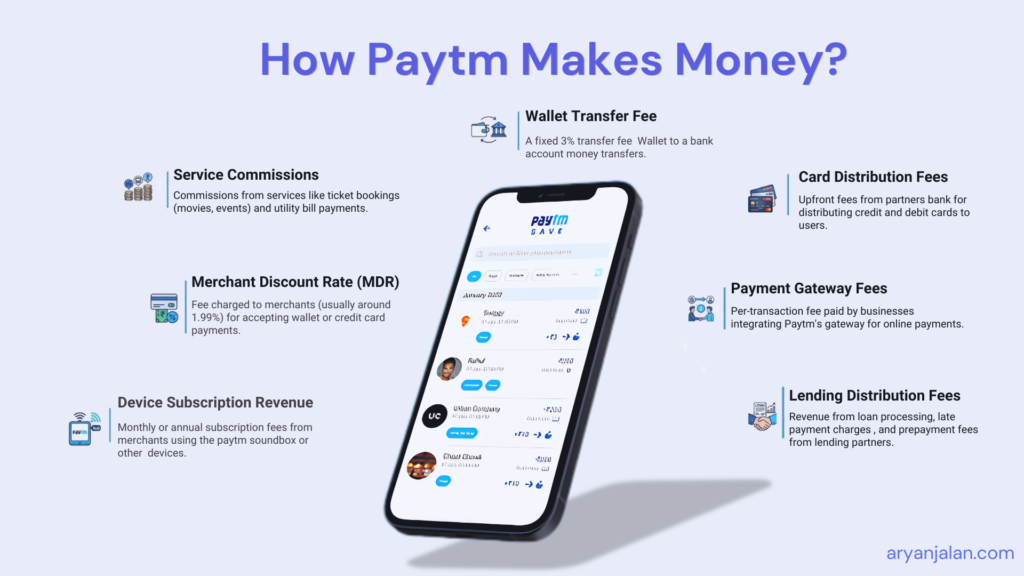
Paytm operates on a multi-revenue business model. Paytm earns from a wide range of users, including individuals, merchants, and businesses.
1. Merchant Discount Rate (MDR)
When a merchant accepts payments through Paytm using wallets or credit cards, Paytm charges a small fee on each transaction. This fee is called the Merchant Discount Rate (MDR) and is usually around 1.99% per transaction.
2. Service Commissions
Paytm also earns a small commission when people use the platform for services like movie ticket bookings, event tickets, or bill payments. These are small charges, but because millions of people use Paytm daily, they contribute to the company’s revenue.
3. Payment Gateway Fees
Businesses that integrate Paytm’s payment gateway on their websites or apps pay a per-transaction fee whenever customers make online payments.
4. Wallet Transfer Fee
Paytm also earns from wallet-to-bank money transfers. When users transfer money from their Paytm Wallet to their bank account, the platform charges a 3% transfer fee.
5. Lending Distribution Fees
Paytm partners with banks and NBFCs to offer loans to users through its platform. In this process, Paytm earns revenue from different types of loan-related charges, such as:
- Processing fees (around 1–3% of the loan amount)
- Default Loss Guarantee (DLG) fees from lending partners
- Late payment charges if borrowers miss EMI payments
- Prepayment or foreclosure charges when users close their loans early
6. Card Distribution Fees
Paytm earns an upfront fee from financial institution partners (like HDFC, SBI, Kotak) for distributing their credit and debit cards to Paytm’s user base.
7. Device Subscription Revenue
Merchants pay a monthly or annual subscription fee to use these devices that announce payment confirmations in real time.
Paytm Competitors
These are some of the major PayTM competitors
- PhonePe
- Freecharge
- MobiKwik
- Paypal
- Razorpay
More About Paytm
- Paytm’s parent company, One97 Communications, was listed on NSE and BSE on 18th November 2021
- As of 2024, Paytm has 1.2 million activated cards in partnership with SBI Card, HDFC Bank, and Kotak Bank
- In August 2022, the Paytm Foundation partnered with UNEP to launch the Air Quality Action Forum (AQAF) to fight air pollution in India
- Paytm was the first Indian payment app to cross 10 crore downloads in 2017
- During COVID-19, Paytm’s PM CARES donation campaign collected ₹100 crore in just 10 days
Frequently Asked Questions of Paytm
1. Who is the founder of Paytm?
Vijay Shekhar Sharma is the founder of Paytm.
2. Is Paytm a Chinese company?
No, Paytm is not a Chinese company. It is an Indian multinational Fintech company founded in 2010 by Vijay Shekhar Sharma. Previously, one of its major investors was Ant Financial, which is affiliated with the Chinese company Alibaba Group, but they also sold their shares to Vijay Sharma in Aug 2023.
3. What is Paytm UPI Lite?
Paytm UPI Lite is a simplified version of UPI for quick and small payments without needing a PIN. All you have to do is add funds up to a daily limit and use them for small purchases without entering your bank details each time.
4. What is unique about Paytm?
Paytm is an all-in-one platform offering a wide range of services like digital payments, insurance, ticket booking, bill payments, mobile recharge, and more. The platform also provides in-house banking services through Paytm Payments Bank.
5. What are Paytm’s First points?
Paytm First Points are basically reward points, also known as Paytm cashback points, that you earn when you make transactions through the Paytm app. You can redeem Paytm first points for OTT subscriptions, brand deals, gift vouchers and Paytm balance.
6. Is Paytm making a profit?
Yes, Paytm is profitable. In Q2 FY26 (quarter ending September 2025), Paytm reported a Profit After Tax (PAT) of ₹21 crore. This includes a one-time charge. Excluding this one-time impact, Paytm’s underlying PAT stood at ₹211 crore, showing great improvement.
7. What happened to Paytm Payments Bank?
In January 2024, RBI barred Paytm Payments Bank from accepting new deposits due to regulatory non-compliances. Paytm migrated its UPI operations to a TPAP model via partner banks (Axis, HDFC, SBI, Yes Bank) and continues to offer payment services through these partners.
8. How does Paytm earn money?
Paytm generates revenue through multiple services on its platform. Its revenue model includes Merchant Discount Rate (MDR) from merchants, payment gateway charges and service commissions. It also earns through card distribution partnerships with banks and subscription fees from devices like the Paytm Soundbox.
Read More About:
1. How Does WhatsApp Make Money?
2. Netflix Business Model
3. Lenskart Business Model
4. Cars24 Business Model
5. Zomato Business Model
6. Uber Business Model