

Most tech companies chase venture capital. Zoho never did.
In FY25, Zoho crossed $1.43 billion in operating revenue. By February 2026, it served over 150 million users and 1 million paying customers.
And it did all of this without raising a single rupee in external funding.
That is what makes Zoho’s business model so worth studying. It is not just about the products. It is about the way they built it.
How Zoho went from AdventNet to a Global SaaS Giant
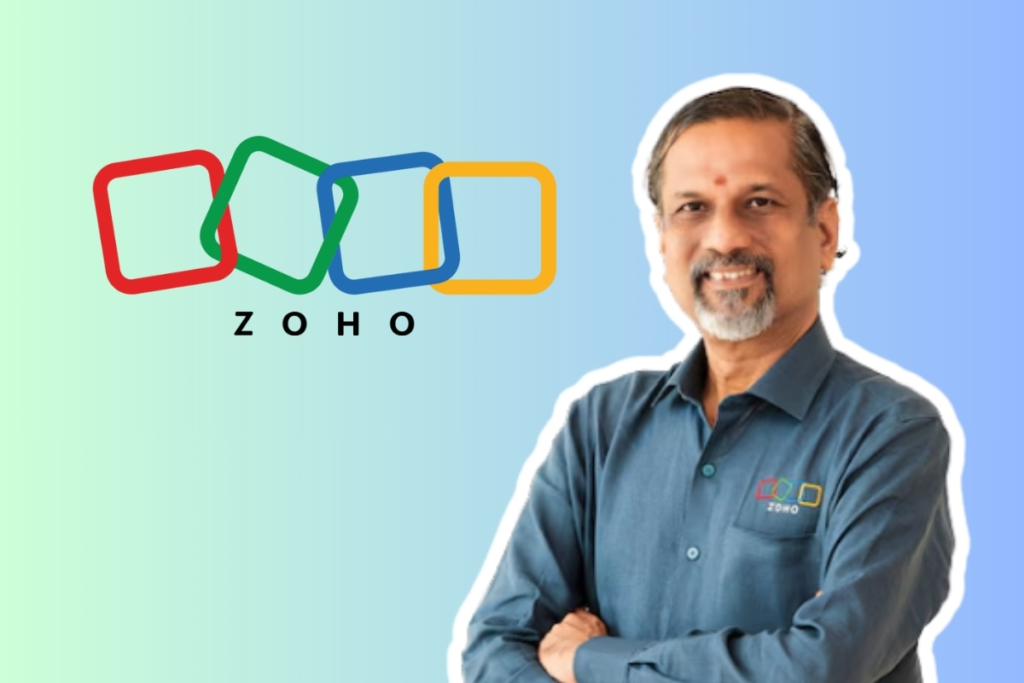
Zoho was founded by Sridhar Vembu, who became Chief Scientist on January 27, 2025, after serving as CEO.
He grew up in a small village in Tamil Nadu, in a typical middle-class family where opportunities weren’t exactly abundant. But what he did have was curiosity.
Everything seemed sorted. But for Sridhar something didn’t sit right.
While working in the US, he noticed a pattern. He saw that many Indians were helping build top global tech companies. Yet India did not have many strong product companies of its own.
That idea stayed with him.
So he made a bold choice. He decided to build something from scratch.
In 1996, he started AdventNet with his brother Kumar Vembu and friend Tony Thomas. The company was based in the US and focused on network management software like WebNMS.
The early days were not easy.
They had very few resources and worked from a small setup. At first, they focused on network management software. Some of their early ideas failed.
But they did not quit. They shifted fully to software. And for them this move changed everything.
One day, a client asked a simple question: “Can you give the same quality as big companies, but at a lower cost?”
It cleared one thing for Sridhar. Big companies were serving large enterprises. Small businesses were often ignored.
So Sridhar made a clear decision. Build simple and affordable tools for small and mid-sized businesses.
This became Zoho’s core idea.
In the early 2000s, the company expanded to Japan and started focusing more on SMBs. In 2002, they launched ManageEngine to offer enterprise IT solutions.
Later on, during the dot-com crash, many of their clients disappeared.
Most companies would cut jobs. Zoho did not. They focused on building better products.
In 2005, they launched Zoho CRM, along with their first office product, Zoho Writer. Over the next few years, they expanded fast: adding tools like Projects, Sheet, and Show in 2006, and collaboration apps like Zoho Docs and Zoho Meeting in 2007. By 2008, they had also entered email and invoicing.
In 2009, AdventNet rebranded to Zoho Corporation. The new name matched its growing suite of online business tools. The company also stayed privately owned, which gave it more control over long-term decisions.
In 2014, it launched its first user conference, Zoholics. In 2017, it introduced Zoho One, an all-in-one suite of business apps. And in 2020, it launched Zoho Workplace, combining its communication and productivity tools into one platform.
Today, Zoho offers a complete set of tools for businesses and works like an operating system for companies.
The Real Foundation Behind Zoho
What truly shaped Zoho wasn’t just its products. It was the philosophy behind it. Sridhar Vembu didn’t chase quick funding or fast growth. Instead, he focused on building something strong and long-term.
Which is why he started Zoho Schools (Zoho University) where students from small towns are trained in real skills and even paid while learning, with many getting jobs at Zoho itself.
He also took a different path by setting up offices in rural areas. Even today, he keeps things simple and focuses more on impact than hype.
In short, Zoho isn’t just a company, it’s a different way of thinking about growth, education, and opportunity in India.
Key Milestones of Zoho
| Year | Milestone |
| 1996 | AdventNet Founded |
| 2002 | ManageEngine launched |
| 2005 | Zoho CRM launched; Zoho Schools starts with six students |
| 2009 | AdventNet renamed Zoho Corporation |
| 2017 | Zoho One launched (all-in-one business suite) |
| 2019 | Zoho revenue crosses $500 million |
| 2020 | Zoho Workplace launched as one unified platform |
| 2022 | Annual revenue crosses $1 billion |
| 2025 | Zia LLM launched; FY25 revenue hits about $1.45 billion |
How Zoho Business Model Works?
Zoho’s model has three layers. Each one supports the next.
The Product Ecosystem
Zoho does not sell one product. It sells an entire business operating system.
The company has 60+ apps. They cover nearly every function a business needs:
- Sales — Zoho CRM, Zoho SalesIQ
- Marketing — Zoho Campaigns, Zoho Social
- Finance — Zoho Books, Zoho Invoice, Zoho Expense
- HR — Zoho People, Zoho Recruit
- IT Management — ManageEngine (a full division of Zoho)
- Collaboration — Zoho Mail, Zoho Cliq, Zoho WorkDrive
- Operations — Zoho Projects, Zoho Inventory, Zoho Analytics
- AI Layers — Zia AI, Zia Agents
A customer comes in for CRM. Then they add Zoho Books. Then Zoho People. Over time, their whole business runs on Zoho. Later on, switching becomes hard. Once you are in, you stay in.
The Subscription Revenue Engine
Zoho makes money through subscriptions. Customers pay monthly or yearly.
There are three entry points:
- Free plans: Limited features. Used to attract small businesses and startups.
- Paid tiers: Priced per user, per month. Scales as a business grows.
- Zoho One: Best-selling bundle of 50+ business apps, starting at $37 per employee/month with annual billing.
Over 90% of Zoho’s revenue is recurring. That means it is stable and predictable.
The Bootstrapped Model
Most tech companies burn investor cash to grow. Zoho does the opposite. Zoho takes its profits. Then reinvests them into research and development.
Zoho invests roughly 60% of its revenue into R&D. The industry average is around 17%. No investor pressure means Zoho can play the long game. They do not chase quarterly earnings. They build for the next decade.
How Zoho Makes Money: Revenue Streams of Zoho
Zoho earned about $1.45 billion (₹12,313 crore) in operating revenue in FY25. That is up about 17.8% from about $1.23 billion (₹10,456 crore) in FY24. Here is where it came from:
| Segment | FY25 Revenue | Share |
| Zoho suite (business apps) | $830 million (₹7,051 crore) | 57% |
| ManageEngine (IT management) | $570 million (₹4,863 crore) | 39% |
| Other products | $47 million (₹399 crore) | 3% |
Total | $1.45 billion (₹12,313 crore) | 100% |
1. Zoho.com Subscriptions
This is the main product division. It includes CRM, Books, People, Projects, and all other business apps.
In FY2025, the Zoho suite brought in approximately $820 million in revenue, accounting for 57% of Zoho Corporation’s total revenue.
2. ManageEngine
ManageEngine is Zoho’s IT management division. It helps companies manage networks, devices, IT services and security. It gives Zoho a second, steady stream of income beside its business apps.
In FY2025, it brought in approximately $566 million in revenue, making it one of Zoho’s biggest business segments.
3. Zoho One Bundle
Zoho One is the all-in-one subscription. It bundles 50+ apps under one price. For businesses, it is a great deal. For Zoho, it increases average revenue per user. It also deepens lock-in.
4. Freemium as a Sales Channel
Zoho does not spend big on ads. Its free plans do the marketing. A startup uses Zoho’s free CRM. It grows. It then upgrades to a paid plan. This model keeps customer acquisition costs low.
Where The Money Comes From?
North America is Zoho’s biggest market, with about 41% of revenue. Asia brings in about 30%. Europe adds about 23%.
What Makes Zoho Different
This is where Zoho’s model goes beyond typical SaaS.
Staying Bootstrapped
Most SaaS companies take VC money. They then optimise for growth at any cost.
Zoho said no to that.
Being bootstrapped means Sridhar Vembu answers only to customers. Not to investors. Not to a board. This gives the company a very different culture and decision-making speed.
It also means Zoho keeps all its profits. There is no dilution. No pressure to go public.
Transnational Localism
This one is unique in the tech world. In 2019 , Sridhar Vembu moved to a village near Tenkasi, a small town in Tamil Nadu. He then shifted some of Zoho’s operations there.
Zoho hires from Tier 2 and Tier 3 cities across India. These employees are smart, loyal, and less likely to leave for a bigger city company. Zoho’s employee attrition rate is far below the software industry average. That saves enormous money and keeps product quality high.
Zoho University (Zoho School)
This is one of the most unique things about Zoho.
The company runs its own school. Zoho University trains students from rural areas who could not afford college. Zoho teaches them software engineering. Then it hires the best ones.
This is not just a social initiative. It is a talent strategy. Zoho gets skilled engineers at a lower cost. And the employees feel a deep sense of loyalty. No other tech company at this scale does this.
Privacy-First Positioning (No Ads Revenue)
Zoho does not run ads. It never has. It also does not sell user data. And it does not use customer data to train third-party AI models.
This is a direct contrast to Google Workspace and Microsoft 365.
For businesses that handle sensitive data (healthcare, legal, finance) this matters a lot. Especially post-GDPR. Zoho’s privacy stance is not just a value. It is a sales pitch.
Full-Stack Ownership (Its Own Data Centres)
Zoho builds and runs its own data centres. It does not rely on AWS or Azure. This cuts infrastructure costs. It also gives Zoho full control over uptime and data sovereignty.
Most SaaS companies pay cloud giants a large chunk of their revenue. Zoho keeps that money in-house.
Its Own AI: Zia LLM and Zia Agents
On July 28, 2025, Zoho launched Zia LLM. An LLM is an AI model that can read, write and answer like a person. Zoho built it in-house on NVIDIA’s computing platform. Most companies rent this tech from OpenAI or Google instead.
Zoho says your business data stays on its servers. It is not passed to the model. Zia LLM runs in Zoho’s data centres in the US, India and Europe.
With it came Zia Agents. Think of them as AI team members inside Zoho’s apps. They handle routine tasks on their own. Zoho launched 25+ ready-made agents in its Agent Marketplace.
Need something custom? You can build your own agent in Zia Agent Studio, with no code.
Zoho’s Key Products and Their Role In The Business
| Product | Category | Role in Business Model |
| Zoho CRM | Sales | Gateway product. Pulls customers into the ecosystem. |
| ManageEngine | IT Management | High-margin enterprise revenue engine. |
| Zoho One | Bundle | Increases revenue per user. |
| Zoho Books | Finance | Competes with QuickBooks and Tally. |
| Zoho People | HR | Keeps mid-size businesses on the platform. |
| Zoho Desk | Customer Support | Competes with Zendesk and Freshdesk. |
| Zia (AI Layer) | Artificial Intelligence | Cross-product AI features, including Zia agents |
Zoho’s Competitors
- Salesforce
- HubSpot
- Freshworks
- Google Workspace
- Microsoft 365
Frequently Asked Questions
1. What is the Zoho business model?
Zoho makes money through SaaS subscriptions. Customers pay monthly or yearly for access to its 50+ business apps in Zoho One. The model is recurring, global, and entirely self-funded.
2. How does Zoho make money?
Zoho earns through three main streams: subscriptions for Zoho.com products, enterprise licensing through ManageEngine, and its all-in-one Zoho One bundle.
3. Is Zoho profitable?
Zoho has remained profitable without venture capital, recording approximately $1.43 billion in revenue in FY2024–25.
4. Who are Zoho’s main competitors?
Salesforce, HubSpot, Freshworks, Microsoft 365, and Google Workspace are the main ones. Zoho competes on price, breadth of products, and privacy.
5. What is Zoho One?
Zoho One is an all-in-one subscription that bundles 50+ Zoho apps. It is priced at around $37 per employee per month with annual billing . It is Zoho’s best tool for maximising revenue per customer.
6. Is Zoho bootstrapped?
Yes. Zoho has never raised venture capital or gone public. It is fully funded by its own profits.
7. Who owns Zoho?
Zoho is privately held. Reported shareholding as of March 2025 lists Radha Vembu at 47.8%, Sekar Vembu at 35.2%, Tony Thomas at 8%, and Sridhar Vembu at 5%.
Read More About:
1. WhatsApp Business Model
2. Paytm Business Model
3. Lenskart Business Model
4. Zomato Business Model
5. Uber Business Model


